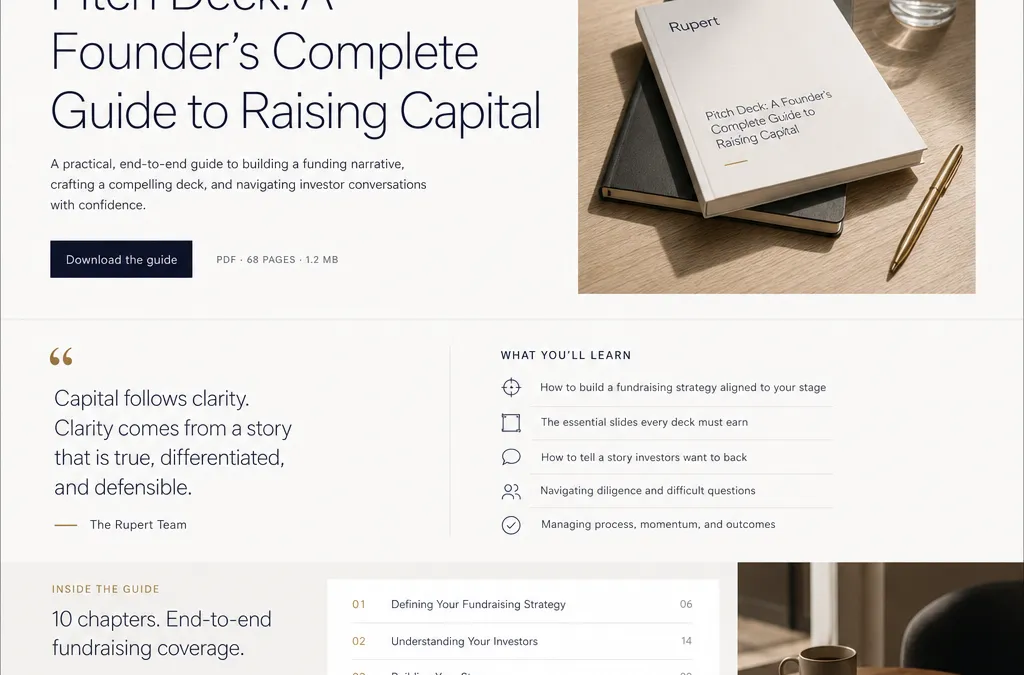
A pitch deck is, at its core, a set of slides — typically between 10 and 15 — designed to communicate your startup’s problem, solution, market opportunity, traction, team, and funding ask to a potential investor. But that definition, stripped of context, flatters the document. The real job of a pitch deck is narrower and more demanding: it is not to close a deal, not to answer every conceivable diligence question, and not to demonstrate the full depth of your thinking. Its job is to earn the next meeting. Everything else is noise that works against you.
Understanding that constraint — the deck as door-opener, not deal-closer — is the first mental shift founders need to make. The second is understanding how much is working against any given deck from the moment it lands in an inbox.
What Investors Actually Do With Your Deck
Investors spend under four minutes per deck on average. That figure should reframe every decision you make about what to include. Analytics tracking first-pass reviews show investors spending an average of around two minutes on an initial look, and decks longer than 15 slides see roughly 40% lower engagement — meaning that every slide you add past the essential set is statistically more likely to hurt you than help you. One of the biggest changes in the current fundraising environment is how quickly investors now screen pitch decks — the first interaction is rarely a deep, time-intensive review, but often a short, high-level scan used to decide whether the startup is worth returning to later.
This pattern has a direct implication that founders consistently underestimate: weak or filler slides do not simply get ignored. They create doubt that contaminates the slides around them. If your market-sizing methodology is thin, investors do not mentally bracket that slide and move on with an open mind — they carry the skepticism forward into the traction slide, the team slide, and the ask. Every slide that fails to carry weight independently becomes a tax on the slides that follow it.
Around 89% of venture capitalists expect a pitch deck during fundraising. The deck is not optional infrastructure — it is the price of entry. But being present in the inbox is far from sufficient. The volume problem is real: AI-generated pitches now flood investor inboxes, making it harder than ever to stand out or be taken seriously. In that environment, a deck that is merely competent is effectively invisible.
The Essential Slides — And Why the Order Matters
Most effective pitch decks contain between 10 and 15 slides, typically covering the problem, solution, market opportunity, product, business model, traction, competition, and team. These are the categories investors expect to see addressed. But the order and relative emphasis are not fixed — they are decisions that communicate your confidence about where your story is strongest.
The conventional sequence — cover, problem, solution, market, business model, traction, team, competition, financials, ask — is conventional for a reason. The best-performing decks tend to follow the same underlying logic: start with the problem, explain the solution, show the market, prove traction, and end with a credible raise. What that sequence is doing is building a logical case: here is why this matters, here is what we built, here is how big the opportunity is, here is evidence that it is working, and here is what we need to go further. Each slide creates the context that makes the next one land.
The problem slide is where this case either ignites or fails. If investors cannot immediately feel the problem — not merely understand it intellectually but recognize it as genuinely painful, genuinely widespread, and genuinely unresolved — the solution slide will not matter. The most frequently cited canonical decks succeeded not through visual sophistication but because they presented a problem that investors could feel in their bones. Across the strongest deck examples, the pattern is not visual style or slide count — it is narrative control, making one risk feel smaller on every slide, reducing market risk with a simple problem and TAM story.
The market size slide is where founders most commonly damage their credibility. Top-down TAM numbers — “$500 billion global market” — are the single easiest signal to an investor that a founder has not done the work. Investors in 2026 prioritize sourced, bottom-up market sizing with named comparables; the biggest red flags include TAM with no sourcing and hockey-stick projections without stated assumptions. A smaller, credible number with a clear methodology is worth far more than a large number that cannot survive a single follow-up question.
The traction slide is the single highest-leverage piece of content in any deck, at any stage. We will return to it in detail below.
The financials and ask slide needs a specific kind of discipline. A few years ago, aggressive growth projections could carry more weight; now investors want to understand how that growth happens and whether it can become efficient. The numbers you put in your projections communicate your judgment as much as your ambition — big numbers without logic create doubt, while better numbers with clear assumptions build trust.
Seed vs. Series A: Two Fundamentally Different Documents
One of the most expensive mistakes in early-stage fundraising is treating the pitch deck as a static document that serves every investor audience equally. It does not — and the gap between what a seed investor needs to see and what a Series A investor needs to see is significant enough that using the same deck for both stages often produces a presentation that fails both audiences simultaneously.
At seed, investors are making a bet. They are asking: could this work? The evidence they need is not exhaustive — it is sufficient. They want to believe the founder understands the problem deeply, that the solution has a credible mechanism, that the market is real and large enough to generate a venture-scale return, and that there is some early signal of demand. At pre-seed, even 500 engaged waitlist users or two signed pilot agreements can be compelling. The goal is not to prove a business — it is to demonstrate that this founder, this idea, and this moment add up to a bet worth making.
At Series A, investors are underwriting execution. They are asking: does this work, and what happens when we add capital? The deck needs to answer those questions with evidence, not assertion. Investors at this stage prioritize real traction metrics — MRR or ARR with growth rate and retention, not signup counts — actual unit economics including LTV:CAC and payback period from real cohort data, and a single proven go-to-market wedge with CAC evidence and scaling signal.
For SaaS companies raising a Series A, the bar in 2026 is roughly $1M–$2M ARR with strong month-over-month growth. Execution-focused team bios matter differently here too — investors want to see exits, products shipped, and customers closed, not just employer logos.
The structural implication is concrete: a seed deck might spend two slides on the problem and one on traction. A Series A deck might reverse those proportions, spend less time on problem setup (which can be assumed), and devote more slide real estate to cohort retention charts, unit economics, and go-to-market evidence. Same slides, different emphasis — but even that level of difference is often not enough. Many founders need to rebuild the deck from scratch when crossing the seed-to-A threshold.
Traction: The Slide That Does the Most Work
Traction is worth treating as its own section because it is the one variable that can compensate for weakness almost anywhere else in the deck. A mediocre market sizing slide becomes less concerning when revenue is growing 20% month-over-month. A team that lacks a famous logo on its bios becomes more credible when pilot customers are renewing at 110%.
At seed, investors expect measurable traction: revenue growth, customer acquisition cost, lifetime value, and churn rates. But even before those metrics exist, signal matters. Pre-revenue startups should present validation signals such as letters of intent, beta usage statistics, or partnership commitments. What you are communicating through any of these is not just that demand exists — you are demonstrating that you have tested the idea against the real world and the real world has responded. That proof of contact with reality is what moves a seed investment from speculative to credible.
At Series A, the traction slide must do heavier lifting. Investors will look hard at retention — specifically whether existing customers stay and expand, which is the most honest signal of product-market fit. Investors also care about whether the business can become more efficient, which is especially important now, when many pay closer attention to burn, unit economics, and realistic paths to scale. A traction slide that shows good ARR alongside deteriorating payback periods or rising CAC is a traction slide that raises more questions than it answers.
Why Most Pitch Decks Fail
The failures are not primarily about design or slide count. They are about narrative gaps — places where the deck asks the investor to make a leap of faith it has not earned. Four gaps appear with disproportionate frequency.
The problem doesn’t feel urgent. Investors fund solutions to problems they find viscerally real. If the problem slide describes an inconvenience rather than a genuine, painful, expensive, or persistent friction, the rest of the deck is climbing a hill the first slide created. The best problem slides can be read in ten seconds and leave an investor thinking: I’ve seen that problem. I know someone who has that problem. I’ve felt that problem.
The team slide doesn’t answer “why you.” Team slides that list logos and titles without explaining why this specific combination of people is uniquely suited to solve this specific problem are one of the most common wasted slides in early-stage decks. Investors are not evaluating whether your team is impressive in the abstract — they are evaluating whether your team has an unfair advantage in this specific domain, at this specific moment.
The market is not sized credibly. As noted above, top-down TAM numbers without supporting methodology are flags, not evidence. A bottom-up approach — here is our target customer, here is the price they pay, here is how many of them exist, here is our share assumption and the logic behind it — is harder to build but far more convincing.
The projections are not traceable to real assumptions. Analysis of rejected decks has found that a large proportion fail on unrealistic projections. A hockey-stick revenue chart without a row-level explanation of how those numbers were built signals to investors that the founder either has not modeled the business or does not want to show the model — neither reading is good. The deck should show that the founder understands the business model and the economics behind the plan.
AI Tools and Design: What They Can and Cannot Do
The explosion of AI pitch deck generators and design platforms has made it faster than ever to produce a visually coherent deck. That is a real benefit for founders who previously spent weeks on formatting. But it has also made it easier to produce a deck that looks considered without actually being considered.
Good pitch deck design in 2026 focuses on clarity and structure rather than visual complexity. That is not a design principle — it is a content principle wearing design language. The clarity investors want is the clarity of a well-constructed argument: a problem that is specific, a solution that is proportionate to the problem, market logic that can be questioned and survive the questioning, and traction that is presented honestly rather than spun. No AI tool generates that, because it requires the founder to have done the underlying thinking.
A founder will usually present the deck live, but the deck still needs to work when forwarded, reviewed later, or skimmed without context — investors often revisit materials internally or share them with partners, and if the slide only makes sense when narrated, it becomes less useful in the actual funding process. AI tools that optimize for visual presentation often produce slides that are dependent on the presenter to be understood. Strong decks are self-explaining.
The strategic thinking that makes a deck compelling — the insight, the narrative arc, the investor-specific positioning — all require founder judgment. AI tools can accelerate the last 20% of the work. They cannot replace the first 80%.
The Deck Is Not the Fundraise
This is the point where many otherwise strong founders lose rounds they should have won. They build a good deck. They send it. They wait.
The deck is the beginning of the process, not the process itself. What happens after the deck lands — how quickly you follow up, how you manage the pipeline, how you personalize outreach to each investor’s specific thesis and portfolio context — is what determines whether a strong deck converts to a term sheet or sits in an inbox accruing silence.
Founders preparing to raise should view the pitch deck, investor outreach approach, and data room not as separate tasks but as different expressions of the same narrative system. The deck opens the door. The follow-up and pipeline management determine whether you walk through it. Founders who treat the deck as a living document — iterating based on investor feedback patterns, adjusting the ask as the round progresses, versioning for different investor profiles — close rounds faster and on better terms than those who send one static file to every investor on their list.
The personalization dimension is particularly undervalued. An investor who funds Series A B2B SaaS does not want to receive the same cold outreach as an investor who focuses on consumer marketplaces. The cover note, the framing of the opportunity, sometimes even the emphasis within the deck itself — all of these should shift based on what you know about who is reading it. That level of research and personalization at scale is where most founders, rationally, run out of bandwidth. Building the company is a full-time job. Running a disciplined investor outreach process is also, effectively, a full-time job.
Where Things Stand
Through the first half of 2026, global venture funding hit a record $510 billion — already surpassing the entire $440 billion invested in all of 2025 — but the headline obscures a historic concentration: OpenAI and Anthropic alone absorbed $217 billion, or 43% of every dollar deployed worldwide, while AI-focused companies captured more than 70% of Q2 global capital, up from roughly 50% a year earlier. For early-stage founders, the squeeze is now quantified: seed deal volume fell 27% in North America’s first half even as total dollars broke records, and KPMG’s Q2 2026 Venture Pulse notes that early-stage activity remains a key watch area — with potential Anthropic and OpenAI IPOs in H2 potentially recycling capital back into the ecosystem. Funded AI decks continue to require a demonstrable proprietary moat over generic AI application, and investors are explicitly asking not “could this work?” but “does this already work — can you prove it?” — raising the traction bar for every slide in the deck.
For most founders, building the deck is the part of the fundraise that feels most under their control — and for good reason. It is. But fundraising does not end when the deck is finished; in many ways, it begins there. The harder, more time-consuming work is identifying the right investors, researching their theses deeply enough to personalize outreach meaningfully, managing the pipeline without letting conversations go cold, and staying organized enough to run parallel processes across dozens of investor relationships without dropping threads.
That is the work that determines outcomes. A mediocre deck with outstanding process will often outperform a great deck sent without strategy. And a great deck paired with a disciplined, personalized outreach process — where every investor receives a message that reflects genuine understanding of what they care about — is where rounds actually close.
Rupert was built specifically for founders at this stage: the deck is ready, the story is strong, and what’s needed now is the research, the personalization, and the pipeline management to get it in front of investors who are actually likely to say yes. Rupert’s experienced operators handle the outreach process end-to-end — every investor researched, every message tailored, every conversation tracked — while founders retain complete visibility into what’s happening and ownership of every relationship. The goal is not to take over the fundraise; it is to run the process with the rigor it requires, so founders can stay focused on building the company that makes the pitch worth funding.
See Related below for more on this topic.
See Sources below for the references behind this article.
Further reading: The Complete Seed Pitch Deck Guide for Raising Founders · pre seed pitch deck · seed funding pitch deck · seed pitch deck examples · seed round pitch deck · angel investors · investor database · series a · startup funding · venture capital.