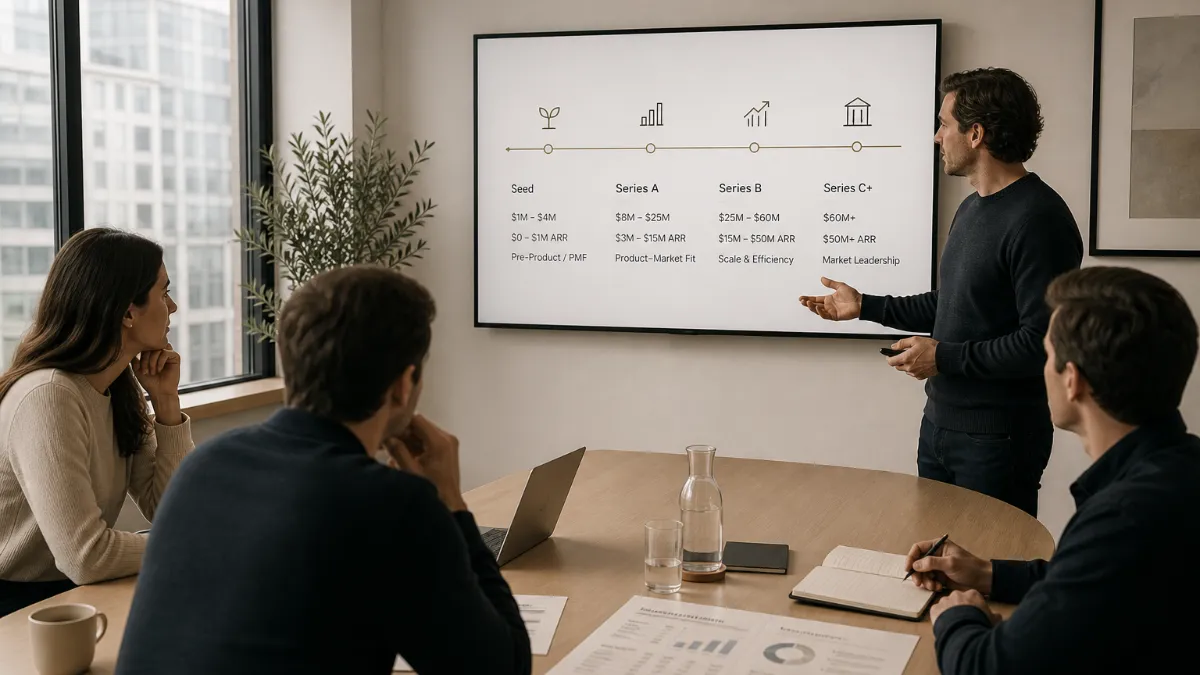
What Series A Actually Is — and Why It Matters
Series A is a startup’s first major priced equity round. A Series A in 2026 is typically $8M to $15M raised at a $30M to $60M post-money valuation, led by an institutional VC who takes a board seat. That sentence is deceptively simple. What it conceals is a structural shift in how a company is governed, financed, and evaluated — a shift that affects every round that follows.
Most founders treat Series A as a bigger version of their seed raise. It is not. At seed, your pitch is a story about a vision, a team, and a market opportunity. At Series A, your pitch is a story about a business that works and a plan to make it bigger. The investors are different, the documents are different, the governance consequences are different, and the failure to appreciate those differences is one of the most common reasons founders walk into the process unprepared.
Series A funding is the first priced round and represents a significant milestone in your startup’s development. It marks the moment you shift your focus from gaining traction to scaling aggressively. That reframe — from proving to scaling — is the right mental model for everything else in this guide.
How Series A Differs from Seed: Structure, Not Just Size
The surface difference between seed and Series A is the dollar amount. The substantive difference is in the legal architecture.
Series A and later rounds use preferred stock. Seed rounds may use SAFE notes or convertible notes instead of priced rounds with preferred stock. That distinction carries enormous practical weight. SAFEs and convertible notes are deliberately light-touch instruments — minimal governance, no board seats, deferred valuation. They are designed to get capital into a company quickly and inexpensively while both sides wait for more information.
A Series A term sheet is a different document in kind. During the Series A round, investors give capital in exchange for equity in the company. This equity is typically preferred equity, providing Series A investors with priority repayment over common stock, liquidation preferences, and board rights. Each of these terms has compounding consequences.
The liquidation preference is typically 1x non-participating; anything else warrants scrutiny and specific negotiation. Anti-dilution protection is typically broad-based weighted-average. Dividends are non-cumulative preferred — cumulative dividends are unusual and heavily investor-favorable. The board composition at Series A is equally consequential. Governance terms define how the company is controlled and on what issues investors have veto rights. A typical Series A board may include five members: two investor seats, two founder or management seats, and one independent director mutually agreed by both sides. Board composition is a meaningful negotiating point, specifically with respect to whether the company’s founders retain majority control.
The terms you accept at Series A set precedents for every round that follows. Accept participating preferences now and your Series B lead will ask why they should take non-participating when the Series A investor got participating. The document you sign at Series A is not just a financing instrument — it is the constitution your company operates under for the next two to four years.
The Bar Has Hardened: What Series A Investors Expect in 2026
The metrics required to earn a Series A conversation have shifted materially since 2021, and founders still benchmarking against that era are setting themselves up for a painful process. The post-2021 funding correction permanently reshaped how investors evaluate Series A companies. Deal counts, valuations, and fund concentration all shifted simultaneously. The result is a market where investors are funding fewer companies, but paying higher prices for the ones they back.
For B2B software, the core readiness signal in 2026 is $1M–$2M ARR growing 2x–3x year-over-year, combined with strong retention. For B2B SaaS, investors typically want $1M to $3M in ARR, 2x to 3x year-over-year growth, net revenue retention above 110%, and clear unit economics. Capital efficiency has become equally non-negotiable. In 2026, investors lead with efficiency metrics like burn multiple and CAC payback, so strong top-line growth with ugly unit economics no longer clears the bar on its own.
It is also worth understanding that these benchmarks shift by category. AI startups have generally raised larger Series A rounds than traditional SaaS in recent years. Valuation multiples are also more divergent, with AI companies often commanding higher ARR multiples than traditional SaaS. Consumer and marketplace businesses face a different evaluation entirely — they are judged on retention curves, unit economics, and evidence of organic growth rather than ARR alone.
The honest framing is this: Series A is where fundraising stops being about promise and starts being about evidence. Seed investors bought your story; A investors buy your spreadsheet.
The Series A Crunch Is Real — and Quantifiable
The gap between the number of seed-funded companies and the number that reach Series A is not a soft market phenomenon. It is structural, and the data is striking.
The Series A conversion rate — the share of seed-funded companies that raise a priced Series A within 24 months — sits at roughly 15–20% as of 2026, according to Carta and Pitchbook cohort data. A decade ago, that figure was closer to 30%. Because seed deal volume exploded while Series A capacity stayed roughly flat, the practical result is that 70–85% of seed companies stall, bridge, or shut down before graduating.
The time dimension compounds the pressure. While companies that are funded at the seed stage are typically raising larger checks, they’re also taking longer to move on to Series A and face lower odds of graduating to that phase at all. Since 2023, U.S. startups have been taking longer to raise a Series A round following an initial seed round of $1 million and over, with that time frame now stretching to more than two years.
The average time from Seed to Series A has stretched to approximately 616 days, according to recent data from PitchBook and Crunchbase. That figure alone should recalibrate how founders think about runway planning. A company that closes seed today and assumes it will raise Series A in 18 months is planning against a median that no longer exists.
The implication is clear: build investor relationships 12–18 months before you pitch. The best Series A deals come from investors who tracked the company through seed stage, met quarterly for updates, and watched progress compound. Proximity to the metrics bar is not the same as being ready to fundraise. Founders should use seed runway to reach the bar — not approach it — and begin relationship-building long before a formal process starts.
Valuations in 2026: How the Math Actually Works
Series A valuations are not a negotiation anchored on ambition. They are anchored on revenue multiples, adjusted for growth rate, retention, and category heat.
Series A pricing in 2026 anchors on forward multiples. B2B software typically prices at 15x to 30x current ARR, with the multiple set by growth rate, retention, and category heat. AI infrastructure runs hotter; commodity vertical SaaS runs cooler. A worked example makes this concrete: $1.5M ARR growing 2.5x with 110% NRR might price around $40M post-money ($1.5M × ~25x, adjusted for round size). The fund then owns 20 to 25% after investing $10M.
Pre-money valuations for Series A rounds in 2026 range from $25M to $80M, with the median around $40M to $50M. Valuation depends heavily on revenue multiple, growth rate, market size, team quality, and competitive dynamics. The AI premium is real and should not be treated as the baseline: much of that increase is concentrated in AI deals; non-AI Series A rounds are still pricing closer to a $40–42M pre-money, so founders should check the AI-vs-non-AI split before benchmarking their own round against the headline medians.
One often-overlooked truth: a $30M post-money valuation that closes beats a $60M valuation that doesn’t. The only valuation that matters is the one investors actually wire money at. Founders who anchor to 2021 comps and refuse to adjust for current market conditions are not protecting themselves — they are pricing themselves out of deals that would have funded years of growth.
Dilution at Series A: The Full Picture
Dilution at Series A is structural, and founders who model only the new round’s headline percentage will be surprised by their actual ownership after close. Dilution is structural. Series A leads target 20% ownership; that number moves less than founders hope. But the new round is only part of the picture. Your seed cap matters now. SAFEs convert at Series A. Stack too many discounted SAFEs and your personal dilution doubles.
The option pool adds another layer. The option pool and refresh are to be included as pre-money — meaning the pool expansion happens before the new investors price the round, which further dilutes existing shareholders before a single new share is issued. Expect to dilute 18% to 25% in a healthy Series A, including the option pool top-up. More than 30% is a warning sign for future rounds.
The cumulative picture across a typical funding journey is sobering. The option pool expansion dilutes founders by several additional percentage points, landing them at roughly 36–37%. Carta’s 2026 dataset shows the median founding team declines to 36% after a Series A. Understanding this math before you sit across from a lead investor is not optional — it determines which terms are worth fighting for and which represent acceptable structural reality.
The Fundraising Process: A Realistic Timeline
Most founders underestimate how long a Series A takes by a significant margin. The active Series A fundraising process takes 4–9 months from first pitch to money in the bank. Founders who budget three or four months often hit month five or six with no term sheet and deteriorating runway.
The process breaks into distinct phases. Refine your deck, build your data room, prepare a financial model with 3-year projections, compile customer reference lists, and build a target list of 30 to 50 firms. This preparation phase alone takes four to eight weeks when done properly, and skimping on it compounds every subsequent step.
The active outreach phase requires discipline in sequencing. Research recommends compressing outreach into 6–8 weeks of focused effort rather than spreading it over several months. The reason: you need all investors to be at a similar stage of conversation simultaneously to create competitive tension. Running a tight process is not just good logistics — it is the mechanism through which leverage is created. Schedule first meetings in batches of 5 to 8 per week over a 2-week window to create compressed timelines and competitive tension. Expect 30 to 50 first meetings, 10 to 15 second meetings, and 3 to 5 partner meetings. Each partner meeting typically involves a 60 to 90 minute deep dive with the full partnership, followed by customer reference calls and detailed due diligence.
The final phase — term sheet negotiation and legal close — adds another four to eight weeks. Series A due diligence takes 90–120 days on average, including financial review, customer reference calls, technical assessment, and legal documentation. Companies with clean financials and well-organized data rooms can compress this to 60–75 days. The implication is that founders need to begin the process with enough runway to absorb a longer-than-expected close without being forced into a position of desperation.
Finding the Right Lead Investor
The lead investor is the single most consequential decision in a Series A process. The lead sets price, takes a board seat, and signals quality to every future investor who will price the Series B.
Target 40 to 60 funds that actually lead Series A rounds in your sector. Expect roughly half to take a first meeting with a warm process, 8 to 12 to go deep, and 1 to 3 term sheets. This targeting logic is more important than most founders appreciate. A warm, personalized introduction to an investor who actively leads deals in your category is dramatically more effective than a broadcast to hundreds of funds. When building your target list, focus on firms that have recent experience in your sector and stage. Review their portfolio for potential conflicts — a firm is unlikely to lead your round if they already back a direct competitor. Warm introductions from existing investors, other founders in the firm’s portfolio, or mutual connections convert at 5x to 10x the rate of cold outreach.
Quality of targeting matters far more than volume. The top 10 VC funds captured nearly 43% of all venture capital in Q3 of 2025, the highest share in at least a decade. Capital is concentrating, which means reaching the right partner at the right fund with a message that demonstrates genuine fit is the work — not maximizing outreach volume. Warm intros help, but they are not required if your numbers are strong and your outreach is sharp. Many Series A rounds today start with well-crafted cold or semi-warm emails. A relevant, personalized message to an investor who funds your stage beats a generic intro to one who does not.
The lead investor’s value extends well beyond the check. Most Series A companies need to hire their first VP of Engineering, VP of Sales, or VP of Marketing within the first 6 months. These hires are critical because they own the systems and processes that drive scale. Your lead investor’s network should be a primary sourcing channel for these roles.
After the Close: Deploying the Capital
Closing a Series A is not the finish line. It is the starting point for the 18–24 month sprint to Series B milestones.
Closing a Series A is a milestone, not a destination. The capital you raised creates an 18 to 24 month runway to hit the metrics needed for a strong Series B. The commitments embedded in your Series A pitch — the growth assumptions, the market size narrative, the unit economics trajectory — become the baseline that Series B investors use to price the next round. Outperforming against the milestones you described is what creates a competitive B process; falling short explains why so many Series A companies struggle to graduate.
Series B investors want to see $8M to $15M in ARR, 2x+ year-over-year growth sustained over multiple quarters, a proven management team beyond the founders, and evidence that the business model scales with capital. Work backward from these benchmarks to set quarterly milestones for your team. Governance matters too: hold your first formal board meeting within 30 days of close. Set a quarterly cadence. Prepare board materials that include key metrics dashboards, financial summaries, strategic updates, and asks for the board.
The capital is deployed to scale product-market fit: growing the team, expanding go-to-market, improving retention and unit economics, and building toward Series B thresholds. What gets founders into trouble in the period after closing is treating the round as validation that the current approach is working, rather than as fuel to discover whether the approach can truly scale.
Running the Process Without Losing the Company
Series A is the highest-stakes fundraising process most founders will run. The combination of compressed timelines, institutional diligence, cap table complexity, and the sheer volume of investor conversations makes it genuinely disruptive to a company’s day-to-day momentum. Founders who try to run it alone, without a structured pipeline or experienced support, often describe the experience as a second full-time job — one that pulls them off product and team for the worst possible four to nine months.
The practical answer is not to outsource the relationship — every investor interaction, every follow-up, every term sheet conversation belongs to the founder. The answer is to structure the work. Researching the right 40–60 funds, personalizing outreach at scale, maintaining a disciplined pipeline, and tracking where each conversation stands in the process are all tasks that benefit from operational rigor. When that infrastructure is in place and managed by people who have run these processes before, the active raise becomes what it should be: a period of focused investor engagement, not an administrative grind.
Getting the investor targeting, outreach sequencing, and pipeline management right determines whether a raise closes in four months or stretches to nine. Rupert provides the experienced operators and complete transparency to run that process without pulling the founder off the product — every conversation, every contact, every investor relationship stays with the founder throughout. In a market where fewer than one in five seed-funded companies reaches Series A, the execution of the fundraising process itself is a competitive advantage.
Where Things Stand
The Series A market heading into the second half of 2026 is defined by a stark divergence: headline venture numbers look strong, but access remains structurally concentrated. As of July 2026, global venture capital hit a record $510 billion in H1 alone, already closing in on the entire 2021 peak of $643 billion. Yet that headline obscures who is capturing the capital. AI now captures roughly 86% of US VC dollars, with OpenAI and Anthropic alone accounting for 43% of all H1 funding. For non-AI founders, the Series A crunch is still very much in force: seed rounds remain robust, but the Series A crunch persists for non-AI startups.
The Q1 2026 PitchBook-NVCA Venture Monitor put the median Series A deal at $19.6M with a $78.7M post-money for the broader market — a 37% year-over-year jump — though that median is heavily skewed by AI deals, and non-AI founders should benchmark against the more modest $40–42M pre-money range. Capital is flowing into fewer companies. While overall funding volumes have improved, investors are concentrating larger checks into startups that already demonstrate category leadership. The structural message for founders preparing a Series A in the current environment is unchanged: the process rewards disciplined preparation, precise investor targeting, and metrics that clear the bar before the process begins — not approaches to it.
Further reading: angel investors · investor database · pitch deck · startup funding · venture capital.
Sources: Series A Funding Guide — How to Prepare and Close … · Series A Fundraising: A Comprehensive Guide · Series A Funding: Your Guide in 2024.