What Venture Capital Actually Is — and What It Isn’t
Venture capital is a form of private equity financing in which investment firms provide capital to startups and high-growth companies in exchange for equity. That sentence is easy to read and surprisingly easy to misunderstand. Venture capital is not a loan — there is no obligation to repay it, but the investor owns a piece of your company from the moment the check clears. It is not a grant — the firm expects a financial return, and a large one. It is not angel investment — although angels and VCs sometimes invest alongside each other, the structures, expectations, and economic motivations are categorically different. Understanding those distinctions shapes everything about how a founder should approach a raise, choose the right investor, and set expectations for what comes next.
At its core, venture capital is a bet on asymmetric outcomes. VC firms are not trying to build a diversified portfolio of steady, predictable performers. They are looking for the rare company that returns the entire fund on its own — and that structural reality determines nearly everything about who VCs fund, how they evaluate companies, and what they expect from the founders they back. Before a founder can use venture capital well, they need to understand how it works from the inside.
How VC Funds Are Structured: The LP/GP Model
Every venture fund is organized as a limited partnership. The limited partners — LPs — are the investors who provide the capital: pension funds, university endowments, family offices, sovereign wealth funds, high-net-worth individuals, and in some cases other funds. LPs commit capital to the fund but play no active role in choosing investments. The general partners — GPs — are the venture capitalists themselves. They source deals, conduct due diligence, make investment decisions, sit on boards, and manage the portfolio over the fund’s lifetime, which typically runs ten years.
GPs earn money in two ways. First, a management fee — conventionally around 2% of assets under management annually — covers the firm’s operating costs: salaries, offices, legal work, and travel. Second, and far more significant, carried interest: typically 20% of the fund’s profits above a hurdle rate. Carried interest is why VCs are financially motivated to find and concentrate on a small number of breakout companies rather than diversify broadly. A fund that produces five modest exits generates modest carry. A fund with one company that returns ten times the invested capital can make every partner wealthy regardless of what happened to the rest of the portfolio. This is not a subtle preference — it is baked into the math.
That math also explains why VCs ask founders about total addressable market with almost tedious frequency. If a fund has deployed $100 million, it needs the portfolio — at aggregate — to return $300 million or more to generate strong carry. No single company needs to do all of that, but each investment must have a credible path to a scale that meaningfully contributes to the fund’s return. A good business with a $20 million ceiling is not a venture business, regardless of its profitability or the talent of the team running it.
The Funding Stage Map: Pre-Seed Through Series C and Beyond
Founders who understand the funding stage map pitch the right investors, set the right expectations, and avoid the most common positioning mistakes. Every stage has distinct check sizes, traction requirements, investor expectations, and valuation norms — and conflating them is one of the most reliable ways to waste months on outreach to investors who were never going to say yes.
Pre-Seed
Pre-seed rounds are the earliest institutional capital, typically ranging from $250,000 to $1.5 million. At this stage, investors are largely betting on the founding team and the thesis — a compelling problem, a plausible approach, and founders who have a credible reason to be the right people to solve it. Traction is often minimal: a prototype, a waitlist, or early design partner conversations. Pre-seed capital is frequently sourced from angel investors, micro-funds, and accelerator programs, not from traditional VC firms with large fund sizes.
Seed
Seed rounds have grown substantially in recent years. Seed-stage median round sizes rose from $0.6 million to $0.9 million based on PitchBook-NVCA data , though deals at strong firms with early traction frequently clear $2–3 million and above. At seed, investors want to see early product-market fit signals: real users, initial retention data, a paying customer or two, and a go-to-market hypothesis that is being actively tested. The founding team’s credibility remains essential, but investors now expect the product to exist and to be working in the hands of someone who chose to use it.
Series A
Series A is where venture capital becomes most recognizable in the public imagination. Rounds here typically range from $5 million to $20 million, though in competitive markets and high-growth sectors they run considerably higher. Series A deal value totaled approximately $26.7 billion during the first half of 2026, up from $19.3 billion in the first half of 2025 , reflecting continued investor willingness to fund compelling businesses at this stage. Investors expect repeatable unit economics, a clear sales motion, evidence that the product solves a real problem at a price customers will pay, and a team capable of scaling a go-to-market function.
Series B and Beyond
Series B through late-stage rounds are about scaling what works. The company has established a business model and proven it can acquire customers efficiently; the question is how fast and how far. Check sizes climb significantly — Series B rounds commonly land between $20 million and $60 million or higher — and investor diligence becomes more rigorous, with closer scrutiny of financials, competitive dynamics, and leadership depth. Pre-money valuations increased 18% to 79% year-over-year across all stages in 2025, with Series C deals securing valuations 79% higher than those of 2024. Late-stage capital concentrates most intensely on proven performers, and the bar for entry has only risen.
What Venture Capitalists Actually Look For
Venture capitalists are highly selective by structural necessity. VCs receive 300–500 inbound pitches per month, read perhaps 50 of them fully, and schedule meetings for maybe 3–5. Most firms invest in a single-digit percentage of deals they review in a given year. That selectivity is not arbitrary gatekeeping — it reflects the reality that every investment carries significant opportunity cost, and partners at any given firm can only actively support a limited number of portfolio companies at once. What earns a meeting, and ultimately a term sheet, is a constellation of things that have to be true simultaneously:
Market size: The addressable opportunity must be large enough to support a company that can plausibly return the fund. Investors are not looking for niche businesses; they are looking for businesses that can become category leaders in markets with durable demand.
Differentiated product with early validation: An idea alone is not enough — there must be evidence that real people have chosen to use the product, and some signal that they will keep using it and tell others about it. Early retention data, even from a handful of users, matters far more than enthusiasm at a demo.
Scalable business model: The unit economics must be capable of improving at scale, not deteriorating. A business that costs a dollar to acquire a customer and earns fifty cents from them is not a venture business, no matter how fast it is growing.
Founding team credibility: VCs are betting on people as much as ideas. They want founders with domain expertise, a credible reason to win in this particular market, and demonstrable ability to recruit, execute, and adapt. The “why you” question is not perfunctory — it is central to how most investment decisions are made.
None of these criteria is a checklist item that can be manufactured. They are signals that emerge from building a real business, and the most persuasive thing a founder can bring to an investor conversation is evidence of progress — however early — that is genuinely hard to argue with.
The Real Tradeoffs Every Founder Should Understand
Venture capital is not the right choice for every company, and it is not a neutral one. Every round of VC comes with real tradeoffs that deserve honest evaluation before a founder decides to pursue it.
Dilution: Each round of financing reduces the founder’s percentage ownership. A founder who raises a pre-seed, seed, and Series A before reaching meaningful revenue may find themselves holding 40–50% of their company before the first institutional check — and significantly less after it. That is not necessarily bad, but it is a permanent choice.
Board representation and governance: Most VC term sheets include provisions for board seats or observer rights. As the company matures, the board grows, and decision-making authority is shared with investors who have their own views about hiring, strategy, spending, and timing. This is often enormously valuable — experienced VCs have seen many companies navigate the same decisions — but it is a structural change in how the company is governed, and founders should understand it going in.
Growth pressure: Venture capitalists need their portfolio companies to grow fast, because the fund’s economics depend on exits that happen within a finite timeline. That pressure is real and can be useful — it forces discipline and urgency. It can also push founders toward decisions that prioritize growth metrics over long-term health, and toward raising the next round before the business is genuinely ready.
Fundraising as a second job: A serious fundraise — from building a target list through managing outreach, tracking conversations, running partner meetings, navigating due diligence, and negotiating a term sheet — is a full-time job that runs for months alongside the actual work of building a company. Founders who treat it as a background task consistently underperform those who run it as a structured, disciplined process.
None of these tradeoffs makes venture capital a bad choice. For companies with genuinely large opportunities and the ambition to capture them, VC is purpose-built. But they do make it a deliberate choice rather than a default one — and founders who take VC without understanding the implications often find themselves surprised by what they agreed to.
Is VC Right for Your Company?
Not every great company should raise venture capital. VC is purpose-built for businesses that can plausibly return the fund — which typically requires a path to very large scale, a large and durable market, and business model economics that improve with growth. Founders building capital-efficient companies, businesses in smaller markets, or companies with steady, profitable growth trajectories may find that VC is misaligned with their actual goals. Angel investment, revenue-based financing, and bootstrapping are not consolation prizes — they are appropriate instruments for different types of businesses, and choosing the right one is a strategic decision, not an admission of failure.
The useful question is not “can I raise VC?” It is: “does my business need and fit the VC model?” A company that can reach $5 million in annual revenue profitably without external capital may have more strategic optionality, more founder control, and more durable ownership by staying off the VC track entirely. A company with a credible path to $500 million in revenue and genuine competitive advantages in a winner-take-most market may find that VC is not just appropriate but essential — both for the capital and for the strategic support that comes with the right firm.
The Practical Process of Raising VC
Understanding the fundraising process is not a secondary concern — it is as important as understanding whether VC is right for your business in the first place. Founders who go into a raise without a clear process consistently burn time, relationships, and credibility.
Building a Target List
The foundation of any fundraise is a qualified investor target list. That means mapping potential investors by stage, sector, geographic focus, check size, fund cycle (a firm near the end of its investment period has different urgency than one that just raised a new fund), and portfolio fit (investors who have already backed a direct competitor will typically pass). Generic lists of VC firms, exported from a database and emailed in bulk, produce the worst outcomes. A list of thirty firms that are genuinely well-matched to your stage, sector, and trajectory outperforms a list of three hundred firms sent undifferentiated outreach.
Warm Introductions
A warm introduction is an introduction to an investor made by a mutual trusted contact who can vouch for the founder — and it dramatically outperforms cold outreach in conversion rates, often producing 5–10x higher response rates and meeting conversion. The mechanism behind this advantage is not politeness — warm intros convert 10–20x higher than cold emails because they carry pre-built trust; an introduction from a portfolio founder, co-investor, or trusted operator signals to VCs that someone with skin in the game has already vetted you.
The sourcing of those introductions is itself a skill. It requires systematically mapping which firms are a genuine fit, identifying who in a founder’s existing network has a meaningful relationship with the right partner at each firm, and then making a targeted, well-framed ask. The best warm intros usually come from people closest to the investor — current portfolio founders, existing investors, and trusted operators in the VC’s network — and founders are advised to map their network systematically, because many already have access to relevant introduction paths they are not using.
Managing the Pipeline
A common pattern is for a founder to get a warm introduction, take the first call, send the deck — then go silent for three weeks because they don’t know what to send next. The investor moves on. The intro was warm; the follow-through was cold. Managing a fundraise requires treating each investor conversation as an active, tracked relationship: knowing where each firm is in the process, what the next step is, who owns that relationship, and when to follow up. Founders who have visibility into their entire pipeline — which firms have been contacted, what was said, where each conversation stands — are better positioned to create and manage momentum, avoid duplicate outreach, and prevent relationships from going cold between conversations.
The Term Sheet and Close
A term sheet is a non-binding document that outlines the key economic and governance terms of a proposed investment. The major economic terms — pre-money valuation, liquidation preference structure, anti-dilution provisions — shape the ultimate outcome for the founder at exit. The governance terms — board composition, protective provisions, information rights — shape how the company is run from the day the round closes. Most founders benefit significantly from working with an experienced attorney during term sheet negotiation, not because the terms are incomprehensible, but because small deviations from market-standard terms can have large consequences that are not immediately obvious.
The 2026 Fundraising Environment: What Founders Should Actually Know
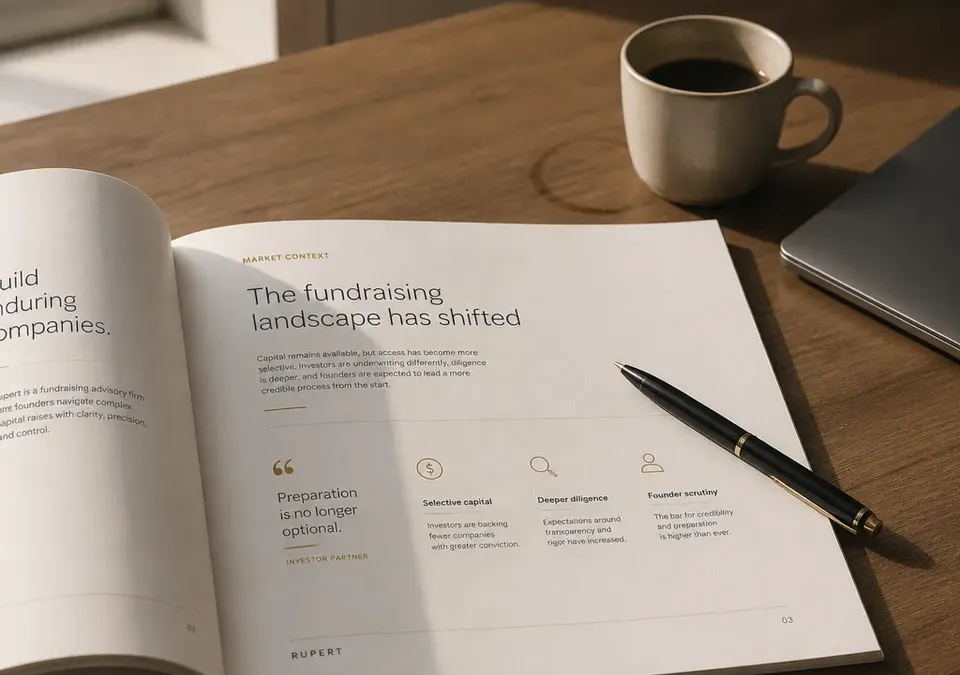
The market exhibits a clear bifurcation: mega-rounds increasingly capture capital disproportionate to deal count, while smaller rounds face headwinds from investor selectivity and larger median check sizes. This pattern, visible across 2024 and 2025, has sharpened further in 2026. For founders, headline funding numbers can be misleading — record global totals driven by a handful of massive rounds do not signal an easy environment for early-stage companies. They signal a concentrated one. Investors are concentrating resources on fewer, more promising opportunities rather than spreading capital across a wide range of startups — which means differentiation and investor-market fit matter more than they have at any point in the past decade. Shotgun outreach to undifferentiated lists is not just inefficient; in this environment, it is actively counterproductive, because it marks a founder as unsophisticated before they have had the chance to make their case.
Where Things Stand
The venture capital market in mid-2026 presents a striking paradox for early-stage founders. The global VC market saw $227.4 billion in investment across 8,440 deals in Q2 2026, making it the second-best quarter on record — yet the number of individual deals fell to its lowest point in ten years, a decline that signals a clear move away from volume-driven activity; investors appear increasingly focused on quality and proven potential rather than spreading capital across many early-stage opportunities, meaning fewer companies secure funding but those that do often receive substantial commitments. Deal count is at the lowest it has been in over a decade, and for founders outside the circle of AI mega-rounds, record funding totals should not be mistaken for an easier fundraising environment.
Early-stage investing remains active but disciplined — Series A deal value totaled approximately $26.7 billion in the first half of 2026, up from $19.3 billion in the same period of 2025 — but underwriting standards remain focused on monetization, capital efficiency, and execution certainty. Over the last couple of years, focus has concentrated on late-stage deals, making it difficult for many early-stage startups not in the AI space — but as capital returns to the market, the early-stage environment may start to improve, which is critical for reinvigorating the broader ecosystem.
See Related below for more on this topic.
See Sources below for the references behind this article.
Further reading: The Biggest VC Firms in 2026: Ranked by AUM, Stage, Sector · biggest venture capital firms in silicon valley · famous venture capital firms · largest venture capital firms by aum · top vc firms · angel investors · investor database · pitch deck · series a · startup funding.